
Is the environment along outdoor power lines really that complex? Yes, it really is! Take distribution lines, for example: they extend deep into the streets and alleys of villages and towns, as well as into farmland, forested areas, industrial zones, and construction sites. The lines are densely packed, the environments are complex, and the areas are highly exposed. For a long time, these complex external environments have been the primary cause of frequent faults in distribution networks.
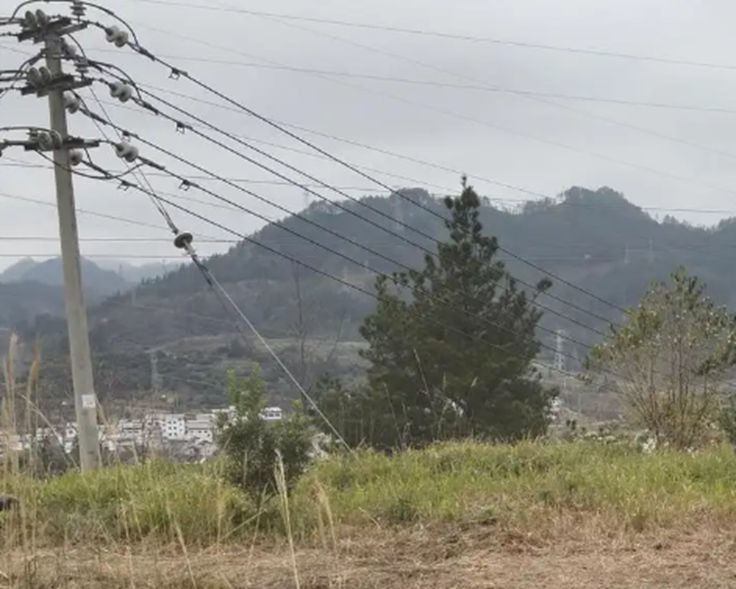
1. Rural and Town Sections: The power lines are strung along rural roads, flanked by rapidly growing trees whose branches and leaves frequently come into close contact with or even cross the conductors throughout the year. During stormy weather, contact between trees and power lines generates electrical arcs, causing tree-to-line short circuits. In farm fields, lightweight debris such as plastic mulch, plastic bags, and crop straw drifts onto the conductors, forming conductive paths that frequently trigger single-phase ground faults.
2. Urban Areas: Illegal wiring is widespread in older neighborhoods, and activities such as construction, store renovations, and debris transport are frequent. External damage—such as large machinery scraping power lines, vehicles with excessive height striking lines, and piles of building materials pressing down on lines—occurs from time to time. In residential areas, kites, banners, and shade nets, as well as dust and acidic or alkaline environments in industrial zones, continuously erode the insulation on power lines.
3. Common characteristics include: Hidden hazards appear randomly, last for a short time, and are difficult to detect through manual inspections. Foreign objects may remain caught for only a few hours, and mechanical malfunctions may occur for only a few minutes; by the time inspection personnel arrive on site, the failure has already occurred.
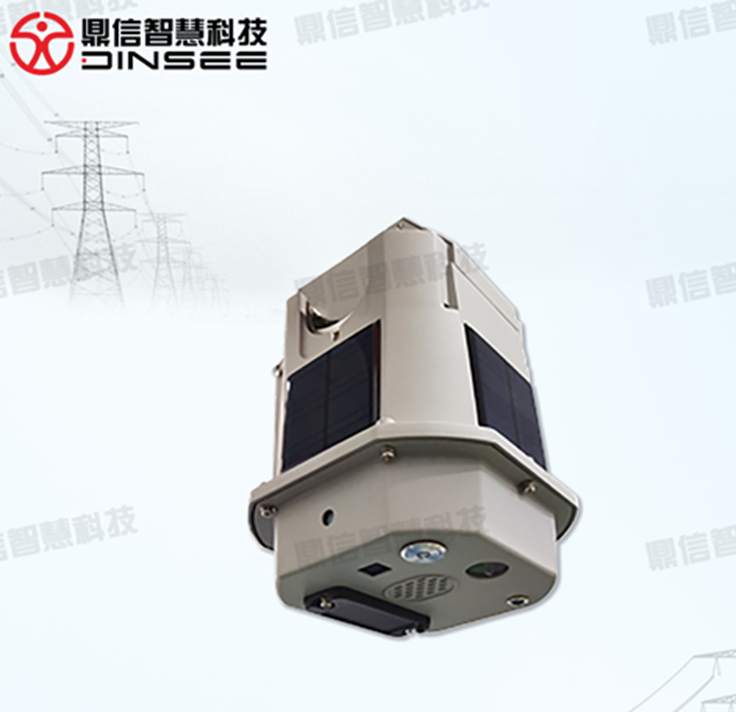
The Dingxin Smart Technology DX-WPS100-JP6 Power Line Self-Powered Tri-Lens Panoramic Audio-Visual Monitoring Device employs a combined panoramic imaging and audio-visual monitoring approach, covering the entire power line corridor, the utility poles themselves, and all surrounding high-risk areas.
1. All-around visibility—no blind spots
Unlike traditional fixed-position cameras, this device features a trichromatic panoramic design that enables horizontal, vertical, and omnidirectional monitoring with no blind spots. The front, rear, and downward-facing cameras operate simultaneously to capture construction machinery and foreign objects directly ahead of the line corridor, unauthorized personnel intrusion, wildfire smoke, the status of equipment at the base of transmission towers, and ground anomalies. It supports all-weather real-time video recording, as well as the capture and transmission of short videos lasting 20 seconds or longer, enabling 360° monitoring with no blind spots. The three camera feeds are recorded synchronously and analyzed independently; any potential hazard detected in any direction can trigger an alarm.
2. Front-End Intelligent Analysis
The device integrates edge computing and deep learning algorithms to automatically identify construction vehicles, cranes, excavators, suspended foreign objects, wildfires, smoke, and unauthorized personnel intrusion. It supports intelligent recognition of multiple types of hazards within a single image. Once the warning logic is triggered, the device immediately transmits real-time footage of the scene to the monitoring center, pushes an alert, and simultaneously activates audible and visual alarms to warn those on-site. On-duty personnel can view the scene in real time via the platform and remotely control the device to rotate and focus on the alert location to verify the incident.
3. Solve the problem of power access and ensure long-term protection
To address the challenges posed by the scattered installation locations of outdoor online monitoring devices and the difficulty of obtaining power, the device employs a dual-power supply system combining CT power extraction and solar panels. It primarily draws power from line induction, with solar power serving as a supplement, eliminating the need for an external mains power connection. A high-capacity 3,000 mAh lithium iron phosphate battery serves as a backup. This multi-pronged approach ensures that 24/7 online monitoring and secure data transmission can be maintained even in unattended conditions.
4. Hassle-free power supply, hassle-free installation
The snap-fit mounting design supports live-line work, allowing for deployment without the need to shut down power. Dual-mode positioning that combines GPS and BeiDou enables real-time tracking of the device’s location. Built-in temperature and humidity sensors detect environmental changes, and the device supports remote firmware updates, resulting in low maintenance costs.
The digitization of power operation and maintenance essentially reinforces the safety baseline of the power grid. The range of online monitoring devices provided by Dingxin Smart Technology not only addresses the issue of “invisibility” but also uses data-driven approaches to proactively address potential hazards.