
Power transmission lines are the backbone of the power grid, with voltage levels ranging from 66 kV to 1,000 kV. They span vast distances, crossing mountains, suburban areas, and wilderness, and operate outdoors year-round without any form of enclosed protection. When a fault occurs, maintenance crews must search an area spanning tens or even hundreds of kilometers; combined with complex terrain and numerous interfering factors, locating the fault often takes an extremely long time.
There are three main causes of malfunctions: natural causes, human error, and wear and tear.
Natural factors account for the largest share. In the spring, wind and sand erode the surfaces of insulators and cause dirt to accumulate; in the summer, lightning strikes and typhoons directly damage line components, and growing trees come into contact with conductors, causing short circuits; in the winter, ice accumulation increases the load on the lines and triggers ice-fall arcing, leading to phase-to-phase faults. All of these phenomena follow distinct seasonal patterns, but their exact timing and locations cannot be predicted.
Damage caused by human activity has been on the rise in recent years. With frequent infrastructure construction in both urban and rural areas, incidents such as heavy machinery accidentally striking power lines, oversized vehicles scraping against lines, and the setting off of fireworks or the release of floating objects near power lines can all directly trigger outages. Such incidents occur unpredictably, making it nearly impossible to ensure round-the-clock, comprehensive prevention and control across all areas.
Equipment aging follows a slow but steady path of deterioration. Oxidation of conductors, rust and loosening of hardware, and deterioration of insulator performance—these hidden issues are difficult to detect during routine inspections. Once they occur, they result in sudden failures that not only drive up maintenance costs but also disrupt the overall power transmission schedule.
The combination of these three factors results in sudden, unpredictable failures of various types that are difficult to troubleshoot. Under the traditional approach, once a failure occurs, the only option is to manually inspect the line section by section, which is inefficient and time-consuming.
The core concept behind Dingxin Smart Technology’s DX-WPS100-GZ01 power transmission line fault monitoring system is to shift from “searching for faults” to “waiting for faults to reveal themselves.”
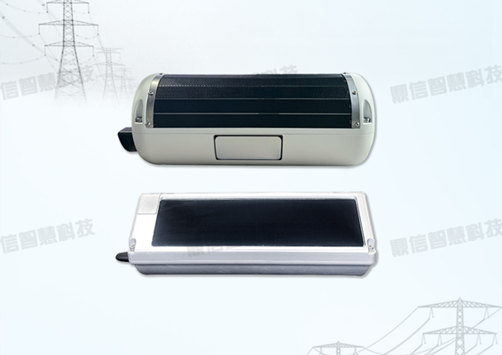
The system installs distributed fault monitoring devices on the conductors of overhead power transmission lines to collect real-time line operation data 24/7 (applicable to both AC and DC lines). It continuously records traveling wave currents for up to 1,000 μs, and both the traveling wave current sampling frequency and the power-frequency current sampling frequency meet grid requirements. In the event of a line fault or abnormal discharge, a high-frequency traveling wave signal is generated at the fault point. This signal propagates along the conductor toward both ends. Monitoring devices installed at both ends of the line capture the initial traveling wave and record its arrival time. By calculating the time difference, the fault location can be pinpointed with a positioning accuracy of less than 100 meters.
The principle behind this distance-measuring system is straightforward: a traveling wave is sent from the fault point, and the time difference between its arrival at the monitoring devices at both ends is proportional to the distance from the fault point to each end. By comparing the two timestamps, the fault location can be determined. The system can also quickly determine whether the fault point lies within or outside the monitored section through phase analysis of the fault current waveform, further narrowing down the search area.
However, the true value of this system lies not only in its response after a failure occurs, but even more so in its ability to prevent failures from happening in the first place.
When line insulation ages or hardware becomes loose, faint discharge signals are generated. These signals have low amplitude and short duration; they are inaudible to the human ear and invisible to the naked eye, making them impossible to detect during routine inspections. The monitoring device can capture the traveling-wave signals generated by these abnormal discharges in real time. After uploading the data to the diagnostic system, the system automatically identifies and extracts fault characteristics using artificial intelligence deep learning algorithms, enabling precise localization of the discharge location.
Early warning data is presented as two-dimensional and three-dimensional trend charts showing amplitude, location, and time. For potential hazard points that recur at the same location with progressively increasing discharge amplitudes, the system proactively sends early warnings to users. This means that operations and maintenance personnel do not have to wait for a failure to occur; instead, they can obtain precise location and trend information while the issue is still in the potential hazard stage and schedule maintenance in advance.
The alert delivery methods have also been designed with practicality in mind. Once a fault is confirmed, the system simultaneously sends alert notifications via text message and the web client, so operations personnel do not need to stay glued to the backend—they can view the fault location and type right on their mobile devices.
In addition, the system covers all voltage levels from 66 kV to 1,000 kV, shifting the logic of transmission line operation and maintenance from “emergency repairs after a failure” to “condition-based maintenance.” Traveling-wave signals never lie, and the data is not affected by terrain or weather; all that’s required is to install monitoring devices on the conductors and let the algorithms do the rest.