
Cable termination towers are the core components of high-voltage transmission systems, featuring the highest level of equipment integration and the highest unit cost. Key components such as termination heads, grounding fittings, copper busbars, lead-in wires, and sensors make extensive use of precious metals like copper and aluminum, as well as precision insulation components; the value of a single set of equipment can reach hundreds of thousands of yuan.
The high resale value has directly given rise to an illegal profit chain. Criminals specifically target remote suburban areas and remote tower sites with weak security, taking advantage of gaps in supervision at night or during holidays to dismantle and steal hardware and copper busbars, which they then sell on the black market for profit. Although only individual components are stolen, the damage extends to the entire line’s grounding system and insulation structure, potentially leading to equipment overheating, insulation breakdown, circuit tripping, and even complete destruction of the line. Since these tower sites are generally located in surveillance blind spots, thefts are highly covert and evidence is difficult to obtain, resulting in organized criminal activity and repeated thefts that remain rampant despite repeated crackdowns.
Dingxin Smart Technology’s Cable Terminal Tower Site Video Surveillance System DX-WPS100-SP5 is designed for this high-risk scenario, providing a comprehensive solution ranging from real-time monitoring to intelligent recognition. Cameras are deployed on terminal towers to cover critical areas such as line corridors, cable ducts, utility poles, and terminal joints. Video data is transmitted in real time via a dedicated 4G/5G wireless network to the monitoring center platform, enabling remote online monitoring and alarm notifications.
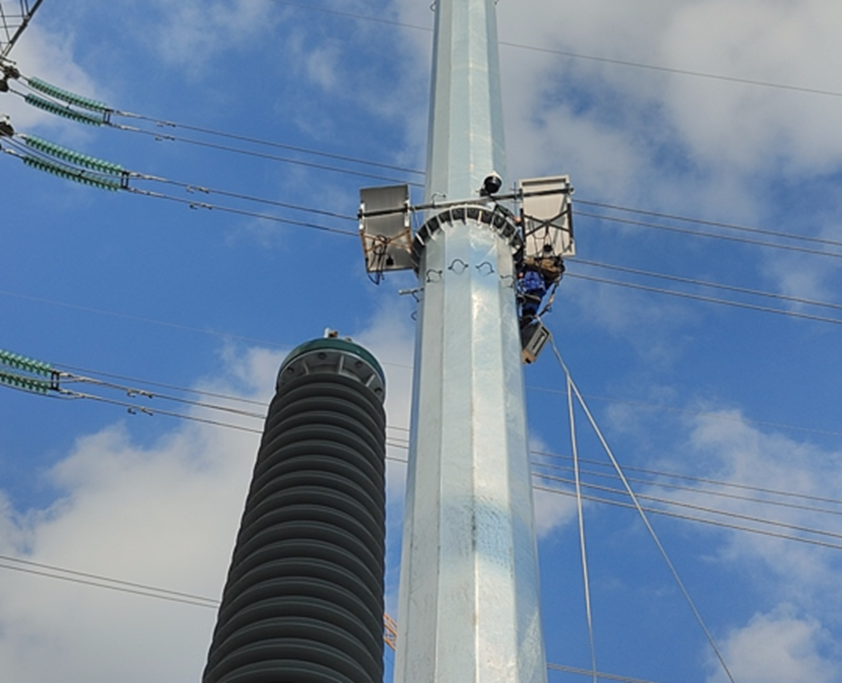
I. Front-end AI recognition; can trigger independent alerts even in offline mode
The system deploys AI recognition capabilities at the front end, enabling devices to autonomously detect on-site anomalies even if communication with the backend is interrupted. The detection scope includes: movement of personnel or vehicles within designated areas, prolonged lingering, and exceeding preset heights; new structures built near power lines, excessively tall trees, heavy machinery entering the site, changes in tower foundation terrain, theft and acts of vandalism, damage to hardware, and foreign objects caught on the lines. Once detection is complete, alert information is uploaded directly without relying on the backend analysis chain, ensuring that alert responses are not delayed by network fluctuations.
II. Multi-mode Operation: Flexible Adaptation to Different Operations and Maintenance Needs
Supports multiple operating modes, including hibernation, standby, scheduled photography, real-time video, and 24/7 operation. The device can automatically take photos at preset times and upload them according to a scheduled timetable, and automatically adjust the data collection interval in the event of an anomaly. Even without manual intervention, the device can continue to automatically capture photos, ensuring uninterrupted monitoring.
III. Comprehensive remote management capabilities with fully adjustable parameters
The monitoring center can remotely control the camera's power on/off function and remotely configure parameters such as focal length, aperture, depth of field, image quality, pan-tilt orientation, and preset positions. When manually switching between camera views, the system automatically displays an OSD overlay with annotations such as "Insulator on Phase C of Tower xx," enabling operations and maintenance personnel to quickly locate the target.
IV. Parallel Implementation of Automatic Line Inspection and Status Monitoring
The device supports automatic patrols along the power line, identifies suspended objects, and generates patrol videos. At the same time, it continuously monitors power supply voltage and communication signal strength, with a minimum sampling interval of 1 minute. It comprehensively monitors and reports battery charge level, battery voltage, charging current, load current, operating temperature, and power supply status. It monitors tower tilt using tilt sensors or image recognition; an alarm is triggered when the tilt exceeds a preset threshold. It features self-testing and fault diagnosis capabilities, with diagnostic results uploaded in real time.
V. System Compliance: Supports Integration with a Unified Video Platform
The equipment complies with the requirements of Interface B in the enterprise standard “Power Grid Video Surveillance Systems and Interfaces” and can be integrated into the internal network’s unified video platform to be managed as part of the overall surveillance system.
The challenge of anti-theft security at terminal towers lies not in “whether to install cameras,” but in whether they will actually be effective once installed. Secondly, the equipment should be able to determine on its own whether to trigger an alarm, rather than waiting for the backend to complete its analysis before taking action. At the same time, multi-parameter status monitoring should be used to include the equipment’s own operational status within the monitoring scope—not only checking for potential theft from the outside, but also detecting any abnormalities in the equipment itself. In high-value, high-risk, and minimally staffed terminal tower scenarios, surveillance must achieve not just “visibility,” but the simultaneous fulfillment of three objectives: “seeing,” “recognizing,” and “accurate alerting.”