
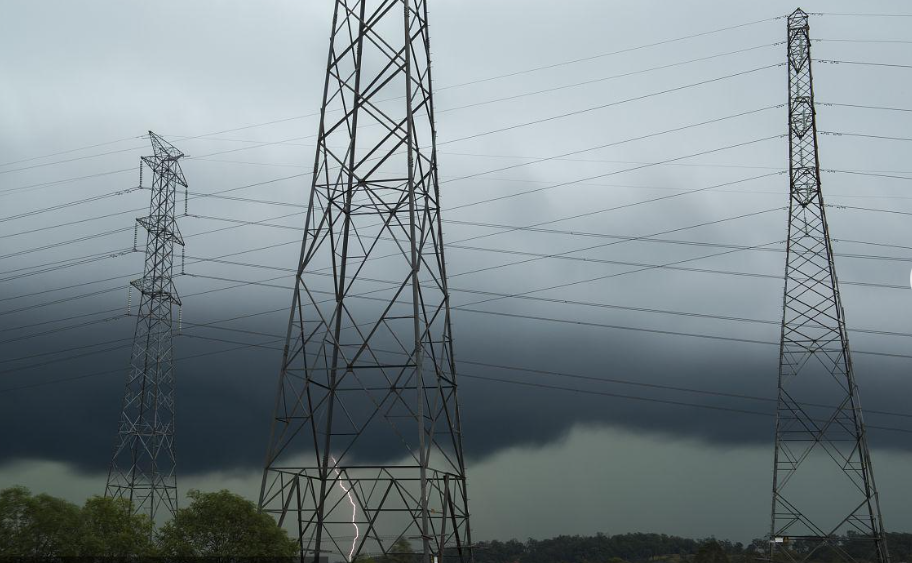
What does a surge arrester do? In a nutshell: When lightning strikes, it takes the brunt of the impact, diverting tens of thousands of volts of overvoltage into the ground to protect insulators, conductors, and hardware from breakdown. When there’s no lightning, it quietly functions as an insulator, causing no trouble at all. Doesn’t that sound reliable?
But here's the problem—this "bodyguard" can run into trouble itself.
Due to prolonged exposure to the elements—including intense sunlight, rain, lightning strikes, and corrosion from contaminants—the body of the surge arrester is deteriorating. The porcelain insulators may develop cracks, surface deposits continue to build up, the internal resistive elements degrade, and once the seals fail, rainwater seeps in, causing moisture damage. Even more insidious are issues such as loose leads, corroded connection fittings, and aging grounding systems; when the current-discharge path is half-blocked, the surge protection performance is effectively cut in half.
What’s the most frightening part? It’s extremely difficult to detect faults in surge arresters. During routine inspections, it’s virtually impossible to tell that they’re operating while faulty. When thunderstorms strike and the surge arresters are supposed to divert the current, they fail to do so, causing the overvoltage to strike the insulators directly—leading to a chain reaction of flashovers, breakdowns, explosions, and short-circuit tripping. If a breakdown occurs directly inside the surge arrester, it can also cause a persistent ground fault, resulting in a permanent power outage along the entire line.
A device that was supposed to protect the circuit has instead become the biggest safety hazard. When you think about it, isn't that pretty scary?
Online Surge Arrester Monitoring Device: Letting Surge Arresters “Report” Their Own Health Status
Dinsee Smart Technology’s Online Monitoring Device for Power Line Surge Arresters DX-WPS100-BL does exactly what it’s designed to do—it equips each set of MOA surge arresters with a real-time monitoring device, eliminating the need for power outages, climbing towers, or disconnecting power lines, and allowing data to be viewed directly from the backend.
The most impressive thing about this device can be summed up in three words: it doesn't use electricity.
1. Energy harvesting from the microcurrent of surge arresters—truly maintenance-free
The device is not powered by solar panels or lithium batteries; instead, it draws energy directly from the leakage current of the surge arrester itself. During normal operation, the surge arrester naturally generates a leakage current in the microampere range, and the device collects this current to power its own operation. It requires no external power source, no periodic battery replacement, and no manual maintenance whatsoever. Once installed, you can simply forget about it.
2. Fully isolated sampling with no residual voltage, causing zero impact on the surge arrester
Current detection uses a wireless remote monitoring device to achieve a fully isolated, residual-voltage-free sampling method. What does this mean? The monitoring process makes absolutely no contact with the surge arrester’s main circuit, introduces no additional impedance, and does not alter the surge arrester’s current-discharge characteristics. It causes zero interference with the surge arrester’s normal operation and poses zero risk to operators.
3. Dual-backup system combining solar power and a lithium-ion battery, with intelligent SOC management
The data acquisition power supply unit is equipped with both solar power generation and eco-friendly lithium-ion batteries, and employs an intelligent SOC control strategy. It charges via solar power during the day and uses the battery as a backup on cloudy days; the system automatically adjusts power consumption based on remaining battery capacity to ensure a long-term, reliable power supply. Even in environments with strong electromagnetic interference, the unit incorporates multiple anti-interference measures to ensure stable data transmission.
Key Parameters: Each One Solves a Real-World Problem
1. Transmission Method: GPRS/GSM Wireless Remote Transmission
Wireless data transmission is enabled via the GPRS/GSM network, allowing monitoring data to be uploaded to the backend in real time so that power utility personnel can check the operational status of surge arresters at any time. There is no need to lay fiber-optic cables or install dedicated communication lines; the system can be used anywhere with GSM signal coverage.
2. Deployment Method: One surge arrester per group
The goal of the system design is to install it on every set of MOA surge arresters to enable centralized monitoring. The price is affordable enough to allow for large-scale deployment—not just as a token installation at key nodes, but to achieve true end-to-end coverage.
3. Interference Resistance: Operates normally in environments with strong electromagnetic fields
Power transmission lines are inherently subject to strong electromagnetic environments, and the electromagnetic field intensity is extremely high during a lightning strike. The device takes interference issues fully into account and employs a variety of effective anti-interference measures to ensure data accuracy even under the most severe electromagnetic conditions.
What exactly makes this thing worth it?
The most distinctive feature of surge arrester failures is that they are “invisible.” By the time you see the porcelain insulator shatter, the damage has already been done. The system monitors each individual set of surge arresters with precision, drawing power from the arresters’ own current to achieve true maintenance-free operation, while fully isolated sampling ensures that the monitoring process does not interfere with equipment operation. The backend no longer simply checks whether “this tower has surge arresters,” but rather determines whether “this set of surge arresters can withstand the next lightning strike at this very moment.”
Instead of waiting for a surge arrester to fail before investigating the cause, it’s better to have it continuously transmit health data from the day it’s installed. After all, how can a surge arrester that can’t even protect itself be expected to protect your power lines?