Given the extensive coverage of distribution lines, complex environments, poor transportation access, and the limited efficiency of traditional inspection methods, routine hazard identification and fault resolution in distribution networks face significant challenges. Distribution lines are numerous, long, and widespread, densely covering various areas such as urban neighborhoods, rural alleys, farmlands, and steep slopes in mountainous and forested areas. With their scattered layout and complex routes, the overall coverage spans a vast area, making comprehensive inspections extremely difficult.
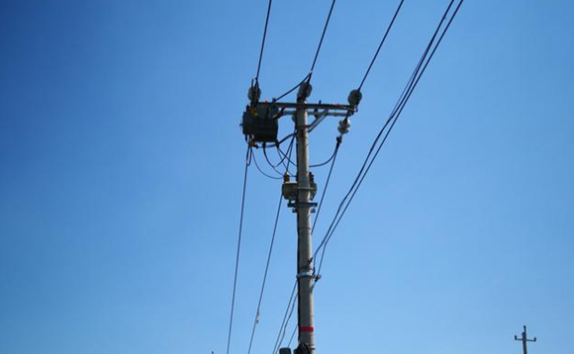
The wide variety of potential hazards, their highly random nature, and their hidden nature represent the core challenges in distribution network operations and maintenance. Power lines run close to residential areas and farmland, and are constantly exposed to external factors such as construction work, plant growth, floating debris, and severe weather. Hazards such as tree-to-line contact, foreign objects snagging on lines, collisions with construction machinery, and tilted poles or towers can arise at any time. However, traditional manual inspections have long cycles and limited visibility, making it difficult to detect a large number of minor defects immediately. These defects are often not noticed until a fault causes a circuit breaker to trip—by which time a power outage has already occurred.
The Four-Eye Framework: From “Looking at a Segment of a Line” to “Looking at the Entire Base Tower”
Dingxin Smart Technology’s Four-View Image Monitoring Device for Power Distribution Lines DX-WPS100-JP5 differs fundamentally from traditional single-lens monitoring systems in that it simultaneously covers four viewing angles—front, rear, downward, and wide-angle—enabling comprehensive, multi-dimensional monitoring of power distribution lines and utility poles.
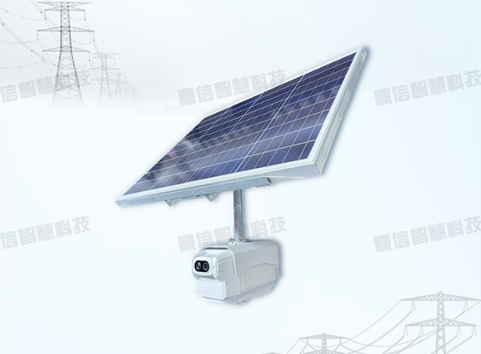
1. Forward-Facing Stereo Camera: 16-megapixel main camera + 2-megapixel starlight-level night vision. During the day, the main camera captures high-definition images; at night, the starlight lens maintains full-color imaging even under extremely low-light conditions. The front-facing camera supports manual vertical adjustment from -30° to +30°, making it suitable for a variety of scenarios—including horizontal straight-line towers, downhill route towers, and uphill route towers—ensuring that conductors, insulators, surrounding trees, and construction machinery all remain within the field of view.
2. 16-megapixel rear-view camera: Covers the opposite direction of travel. The rear-view camera also supports vertical adjustment from -30° to +30°, providing two-way coverage in conjunction with the front-view camera to eliminate blind spots associated with single-direction monitoring. When the route follows the course of a highway or river, the front and rear cameras can simultaneously monitor traffic in both directions.
3. 120° Wide-Angle Downward View: Specifically designed to monitor the tower base. The tower base is a high-risk area for damage caused by external forces—such as excavators colliding with the base, vehicles crossing overhead power lines, or debris piled up around the base—and these hazards are completely invisible from above. The 120° wide-angle downward-view lens provides a broader field of view at the same mounting height, offering a clear, unobstructed view of the tower base and its surroundings.
4. Front-end AI: Automatic recognition with 98% accuracy
The device’s front end integrates intelligent analysis algorithms that can automatically identify targets such as construction machinery, cranes, excavators, smoke, wildfires, suspended foreign objects, trees exceeding height limits, and vehicles crossing overhead power lines, with an identification accuracy rate of 98 percent. Alarm images are uploaded in real time to the monitoring center via 4G, 5G, or APN networks, eliminating the need for manual review of video streams one by one.
Independently powered, can be installed anywhere
A 9.6V/20AH lithium iron phosphate battery paired with a 30W solar panel allows for operation completely off the grid. The mounting bracket supports 360° horizontal adjustment of the main unit and solar panel, as well as 180° vertical adjustment of the entire bracket, making it compatible with various pole types and installation orientations. No custom brackets are required on-site; installation can be completed as soon as power is connected.