
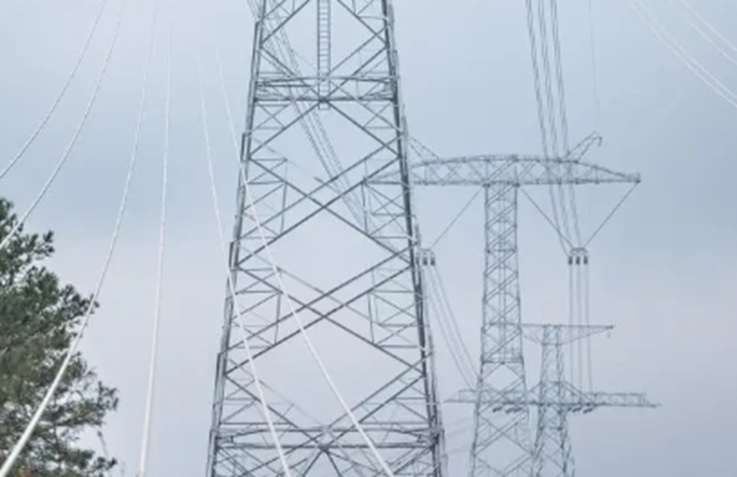
In power system operations and maintenance, we must not only focus on the conductors and the equipment itself, but also remain vigilant about dynamic changes in the right-of-way on both sides of the towers and the areas surrounding the tower bases. In fact, these hidden hazards are a major source of sudden power outages.
Threats within the right-of-way come from two directions. First, uncontrolled vegetation growth—with towering trees and wild plants constantly encroaching on the power lines—reduces the safety clearance, making it extremely likely to trigger flashovers and phase-to-phase short circuits during thunderstorms and high winds. Second, flammable materials such as straw, debris, and construction waste that accumulate within the right-of-way can ignite upon contact with an open flame, posing a direct threat to the safety of transmission towers by creating a risk of wildfires.
Risks affecting the exterior of the tower foundation are even more destructive. Illegal soil extraction, unregulated excavation and construction, and foundation pit excavation can damage the soil structure around the foundation, leading to soil loosening and erosion, as well as settlement or tilting of the tower foundation. Heavy rain erosion and persistent water accumulation can further weaken the stability of the tower, potentially causing it to collapse in extreme cases. Additionally, construction-related compaction around the tower base can easily damage grounding systems, significantly reducing lightning protection capabilities. These hidden hazards develop slowly and are difficult to detect in the early stages, but once they accumulate to a critical point, they often directly escalate into major failures.
Traditional monitoring methods have limited ability to detect such hazards. The main reasons for this are: the complex environment of the conduits, the diverse types of hazards, and their rapid dynamic changes. Relying solely on visible-light image recognition can easily lead to false alarms and makes it impossible to accurately determine the spatial distance between the hazards and the conductors.
Dingxin Smart Technology’s DX-WPS100-JG3External Break Online Monitoring System (Millimeter-Wave Radar) utilizes millimeter-wave radar technology operating at a frequency of 76–81 GHz (wavelength approximately 4 mm) to detect minute movements on the order of millimeters, enabling precise measurements of a target object’s distance, angle, height, and speed. The high accuracy resulting from the short wavelength enables the device to precisely identify the relative position between external break hazards and conductors within a 30-meter range (configurable), providing in-depth information to support operational and maintenance decision-making.
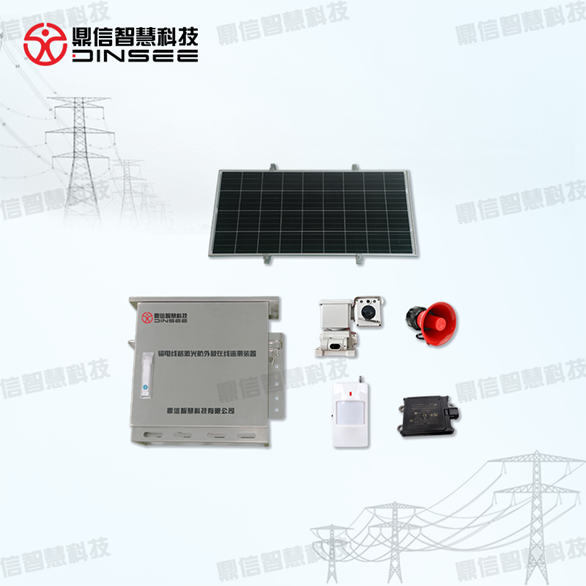
The dual-verification mechanism is at the core of this system’s design. The device supports two trigger paths: In radar-triggered mode, the visualization terminal controls the radar to activate every 2 minutes; once the radar issues an alarm, it immediately triggers image capture and AI recognition for dual verification. In AI-triggered mode, if an AI alarm is triggered during scheduled image capture, the system activates the radar to capture the alarm status. Only when both the AI recognition alert and the radar alert are triggered simultaneously does the system upload the alert image to the platform; the image automatically overlays the radar alert status and the location of the potential hazard. This dual-verification logic significantly reduces the false alarm rate associated with a single recognition method.
In terms of monitoring range and scenario coverage, the device can detect potential external damage hazards caused by moving objects within a vertical range of 10 to 700 meters and a horizontal range of 80 meters. Typical scenarios include construction vehicles such as tower cranes, boom cranes, and excavators, as well as trees that have grown over time within the passageway. Additionally, the system can filter out non-external-damage targets that have been present in the passageway for a long time (such as construction equipment parking areas), further reducing false alarms.
In terms of installation accuracy, high-precision coordinate transformation and hidden-object registration can be achieved by verifying three sets of parameters: the position of the visualization system relative to the tower-line system, the relative positions of the camera and the millimeter-wave radar, and the camera’s own parameters.
From power lines to tower bases, from treetops to foundation pits—blind spots are not blind because they don’t exist, but because no one is monitoring them. The external damage prevention online monitoring system (millimeter-wave radar) integrates features such as corridor visualization, standardized sensor integration, AI edge computing, radar ranging, and ultra-low power consumption, focusing on addressing the monitoring needs for preventing external damage along utility pole corridors. Millimeter-wave radar compensates for the distance-measuring limitations of visible light, while AI compensates for the recognition limitations of radar. The alarm information generated through cross-validation of these two technologies provides practical value that truly guides O&M decision-making.