
Many people wonder: What dangers could arise if high-voltage power lines were completely encased in a thick layer of ice?
As ice continuously accumulates on conductors, insulators, and steel tower frames, the overall load increases exponentially. With towers subjected to prolonged overloads, vulnerable sections are highly prone to bending and collapse, leading to a series of accidents involving broken wires and fallen towers. After icing, the conductors become stiff and taut; during high winds, they swing violently back and forth, making it highly likely for them to come into contact with one another and cause short circuits, resulting in widespread power outages. When insulators freeze, their insulating capacity drops sharply, making them highly prone to surface flashovers and electrical leakage, which pose a risk of electric shock; when ice blocks fall, they not only damage facilities along the power lines but can also ignite vegetation in forests and grasslands, creating an additional risk of wildfires.
The widespread ice storm that struck southern China in 2008 serves as a painful lesson from the past: in the mountainous regions of Guizhou, the thickness of ice on many power lines exceeded 70 millimeters—far surpassing the lines’ design load capacity—resulting in the collapse of numerous utility poles and towers and forcing the shutdown of over a thousand power lines. Ice and snow blocked mountain roads, preventing emergency repair crews from reaching the affected areas for an extended period. As a result, water and heating supplies in cities were disrupted, factories of all kinds halted operations, and both people’s livelihoods and the economy suffered enormous losses.
For a long time, preventing freezing on power lines during winter has relied heavily on manual inspections. Inspecting sections in deep mountains and windy areas is difficult and risky, making it hard to monitor the continuous thickening of ice in real time. By the time severe icing is detected with the naked eye, a failure has often already occurred, and subsequent emergency repairs are time-consuming and labor-intensive. Consequently, early monitoring of icing conditions and proactive prevention and control of icing-related incidents are essential tasks for winter power grid operation and maintenance. Dingxin Smart Technology has specifically developed simulated conductor icing monitoring equipment to address the various challenges of traditional visual icing inspection through intelligent solutions.
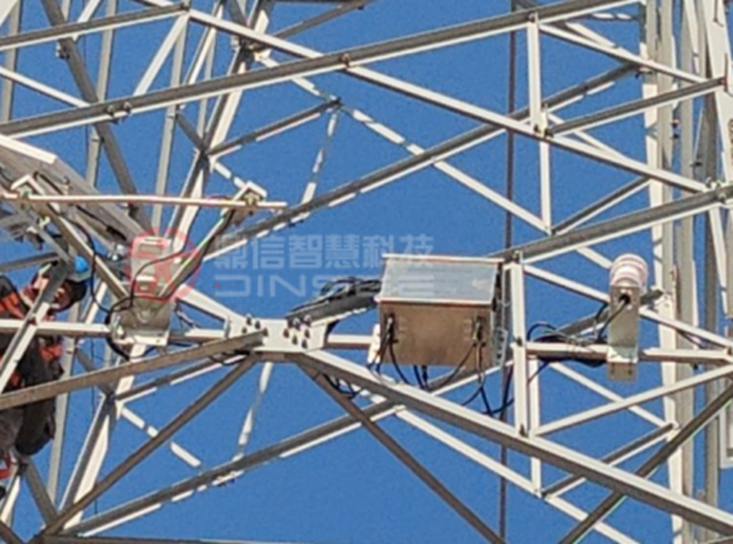
This device supports live installation without power interruption, ensuring that normal power supply operations are not disrupted and enabling more efficient on-site deployment. Equipped with a high-definition imaging module, a high-precision tension sensor, and a voltage-stabilized power supply unit, the device continuously captures real-time images of the power lines. Leveraging multi-mode wireless transmission—including 4G, 5G, Wi-Fi, and LoRa—it reliably transmits video footage, ice thickness measurements, and warning alerts to the cloud-based backend in real time, whether in suburban areas with strong signals or remote mountainous regions with weak signals. This enables staff to view the actual on-site icing conditions anytime, anywhere.
The device integrates an edge computing unit, an analog wire data acquisition module, meteorological sensor components, a starlight night vision lens, and a de-icing module. The system calculates ice thickness by comprehensively analyzing on-site imagery and various meteorological parameters. By leveraging the physical and electrical characteristics of the analog wires to build a dedicated mathematical model, it accurately quantifies ice buildup, predicts the subsequent rate of ice growth, and identifies potential hazards at the earliest possible stage.
In terms of outdoor battery life, the solar power modules have been reinforced to withstand wind and snow accumulation, ensuring a stable power supply even in extremely cold, rainy, or snowy conditions. The data collection interval can be flexibly adjusted remotely, and the accompanying mini-program and app facilitate mobile operation and maintenance management. Data is fully encrypted and protected throughout the process, enabling seamless integration with the unified management platforms of State Grid and China Southern Power Grid.
The complete set of equipment for simulating ice accumulation on power lines enables round-the-clock, unmanned monitoring, shifting ice prevention and control from post-incident repairs to preemptive early warning, thereby ensuring the safe and stable operation of transmission lines throughout the winter.