
In power grid operations and maintenance, there is a particularly problematic blind spot:
Hazards such as tree growth, floating debris, and construction equipment can easily come into close proximity to overhead power lines. Standard surveillance cameras may capture images of a crane beneath the lines or tree branches very close to them, but just how close are they? Relying on visual estimation is highly subject to the effects of angle and perspective. It might look like a collision is imminent, but there are actually still several meters to spare; it might seem quite far away, but a gust of wind could trigger an electrical discharge. This “difficulty in judging distance” means that operations and maintenance personnel are often reluctant to shut down power blindly, yet they also cannot simply ignore the situation. As a result, they have no choice but to send someone to climb the hill to verify the situation on-site—a time-consuming and labor-intensive process.
To address the challenge of determining “clearance distance,” Dingxin Smart Technology has launched the DX-WPS100-SP8 Overhead Power Line Image and Video Monitoring Device (Distance-Measuring Type). As a distance-measuring visualization monitoring device, it is not merely a camera but also an “online visual rangefinder” capable of converting on-site image data into spatial clearance distance data. As soon as the calculated clearance distance approaches the safety threshold, the system immediately triggers a pop-up alert and transmits an image containing the distance data to the backend, enabling the quantitative identification and early warning of potential hazards along power transmission corridors.
Core Operating Principle
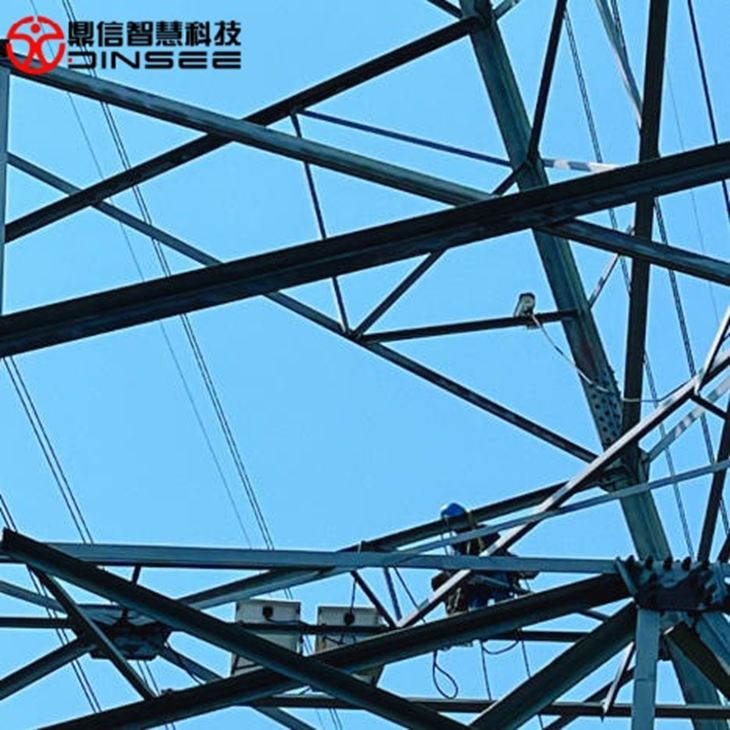
The DX-WP S100-SP8 Overhead Power Line Image and Video Monitoring Device (Range-Finding Type) consists of a main unit and auxiliary units that together form a complete monitoring system. It is installed at designated locations on utility poles based on the conditions at the project site.
The primary camera remains stationary, while the auxiliary camera rotates on its pan-tilt mount; the dual-camera units simultaneously capture images of the target and the power lines from different angles. Using feature matching, geometric calculation, and 3D spatial reconstruction algorithms, the system automatically calculates the spatial distance between the power lines and intruding objects. Once a hazardous target is identified or an object’s distance falls below the safety threshold, the system automatically triggers an alarm and simultaneously uploads the associated image data, allowing operations and maintenance personnel to remotely verify the situation and arrange for corrective action—eliminating the need for guesswork.
Core Product Capabilities
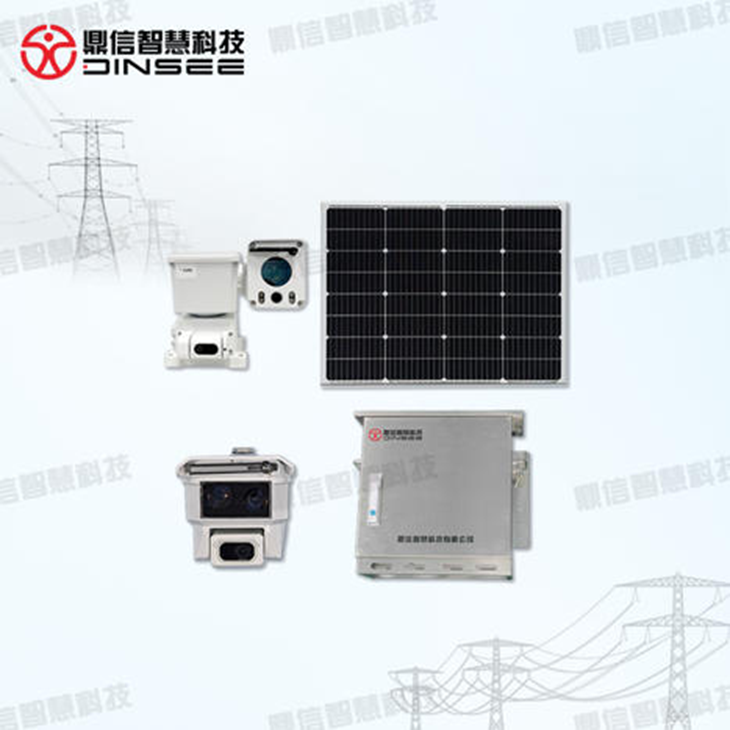
The device’s standout feature is its “dual-camera (primary and auxiliary)” design, which addresses the limitation of a single camera’s inability to measure distances.
1. Main Unit (Fixed Post): An integrated camera system is responsible for continuously monitoring key directions, providing a comprehensive view of the entire area.
2. Auxiliary camera (mobile sentry): Equipped with a pan-tilt head, it is responsible for panning and scanning, as well as verifying details; two cameras work in tandem to calculate spatial distances.
3. Dual-Channel High-Definition Imaging and Distance Measurement: Both the main unit and the auxiliary unit are equipped with dual-channel distance-measuring cameras with effective pixels of ≥8 million, ensuring that image capture and distance measurement occur simultaneously.Effective pixels in the visible light spectrum are ≥16 million.
4. Multi-dimensional detail capture: The main camera is equipped with a ≥2-megapixel night vision and wide-angle lens; the auxiliary camera features a wide-angle lens with ≥2 megapixels and a zoom lens with ≥4 megapixels, supporting ≥40x optical zoom.
5. High-precision 3D distance measurement: The measurement range covers 40 to 500 meters, with measurement error controlled within 0.5 meters. It can output multiple sets of data, including horizontal distance, vertical elevation difference, and the clearance distance between potential hazards and power lines.
6. AI-Powered Target Recognition: Automatically identifies various intrusion hazards within the passageway, such as tower cranes, construction machinery (cranes, excavators, dump trucks, etc.), wildfires, and foreign objects.
7. Intelligent Line Corridor Analysis: Features built-in sag calculation and tree growth analysis models to continuously track changes in conductor sag and tree growth trends, and predict the risk of tree-related obstructions.
8. Dynamic Monitoring of Conductor Wind Deflection and Flutter: Collects real-time data on conductor wind deflection and flutter, and outputs monitoring metrics such as wind deflection angle and flutter amplitude.
9. Wide-range pan-tilt patrol: The pan-tilt unit supports continuous rotation from 0° to 360° horizontally and covers a vertical range of -90° to +90°; it can be preset to monitor ≥256 locations.
10. Connectivity: Compatible with 4G networks from China Telecom, China Unicom, and China Mobile.
11. Real-time Monitoring: Supports 7×24-hour uninterrupted monitoring.
Hardware and Installation
1. Power Supply System:
Total power of solar PV modules ≥ 350 W
Battery Type: Lithium Iron Phosphate Battery
2. Hassle-free installation
Suitable for all types of towers ranging from 35 kV to 1,000 kV. The system features a non-contact installation method that requires no power outage, allowing for rapid deployment without disrupting normal power supply to the line.
A circuit trip often comes down to a safety distance of just “a few tenths of a meter.” The true value of the DX-WPS100-SP8 distance-measuring image and video monitoring device lies in letting the data speak for itself, thereby eliminating unnecessary trips. At a time when extreme weather events are frequent and hazards along transmission corridors are becoming increasingly complex, pinpointing the distance to hazard sources to within 0.5 meters marks a new phase of spatial quantification. Replacing vague experience with accurate data enables the precise issuance of defect-removal instructions, thereby pushing the safety line forward.